Friday, September 22, 2006

Action Painting

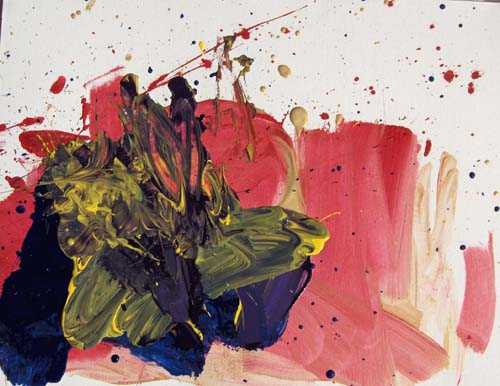
It was sunny today. On the spur of the moment, I broke out the paints and canvasses for our action painting lesson.

Lovely young lady, eleven, went first. "I don't like painting," she said. "I might get paint on my clothes," she said. "Do I have to?" she said.

("Hmm," I said. "Wear this," I said. "Yes," I said.)

"Wow, that looks COOL!!" she said. "Can I display it on the wall?"


Fine young gent, three. A traditional young man, he was a little disconcerted at the idea of dripping and flinging paint.


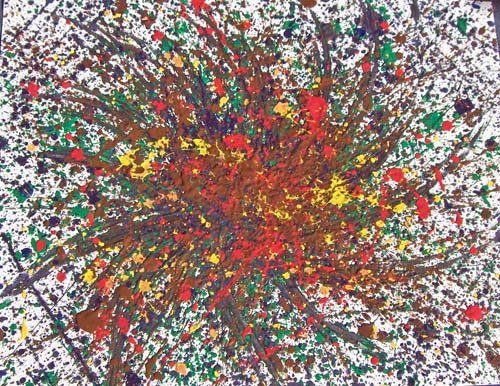
Dancing, spinning, splatting. Fine young gent, five, was in his element. His performance was as much a work of art as his painting. "Mom, I paint just like Jackson Pollock!" he declared at dinner, which led us in a roundabout way through a discussion of creating unique works of art and on to, of all things, fractals. My mathematical husband had to add to my rather fuzzy description. My admittedly muddled understanding of fractals, vaguely remembered from a couple articles read long ago, one related to a study of fractals in Pollock's paintings (this takes a while to load, but it's interesting even if your understanding of fractals is a bit muddled), doesn't lend itself to clear explanation. The bonus outcome: The kids are interested in learning more about fractals, and so am I.

Lovely lady, thirteen. Her vision was of an autumn tree, the viewer looking straight down from the sky. I forgot to ask if she planned it from the beginning, or if that's what her painting brought to mind when she was finished. Either way, it's really cool.

Thursday, September 21, 2006

Maps


We made a map of our neighborhood today, blocks on poster board. Yesterday we went for a walk and sketched our street; today we collaborated to create a 3-D map. Lovely lady with autism had a meltdown in the middle of the project. Lesson learned: Schedule group projects in the morning, and assign her a very specific task before we begin working. All in all, it was great fun. The ladies and gents traced around the blocks, so we've got a map of the street hanging on the wall.

Apparently there's a castle-parking garage at the end of our street that accommodates both knights and Hot Wheels. Yeah, that's what I tell everyone when I give directions, "Turn right when you get to the castle. You can't miss it. It's a great place to park your race car or your noble steed."

Wednesday, September 20, 2006

Miquon Math Labs

We've already got a curriculum rave. Miquon Math Labs.


With a late fall birthday, kindergarten fine young gent would have started public school this fall. But he was asking to learn to read a year ago, so we started what we loosely called kindergarten. I chose a handwriting book because he wanted to learn to write letters, and math curriculum, and decided to wing it for the rest. Wouldn't you know, my normally relaxed about the whole thing self agonized over math curricula. First of all, was a math curriculum even necessary for a young kindergartener? Secondly, which one? Aaaughh, the dilemma posed by too many choices. And third, when am I going to learn to relax and not worry about it? It's kindergarten, for Heaven's sake. So I chose Horizons Math, a good solid workbook-based program with a lovely teacher's guide that I opened maybe twice.

(And, ugh, the whole workbook thing, that's a whole 'nother post. Wouldn't you know it, this workbooks-are-bad, "I believe in activity-based developmentally appropriate learning activities in early childhood" mom-- that would be me-- has kids who LOVE workbooks? God really wants to teach me to laugh at myself.)

Fast forward to this year. I've had a whole school year of taking myself way too seriously, so I decided to take this year off and behave like a normal rational being. Kindergarten is not the make-or-break year mathematically. It's not like he'll never master algebraic concepts, nor is it likely that he'll fail miserably at calculus if we choose the wrong kindergarten curriculum.

So what the hey? I'll give Miquon Math a whirl.

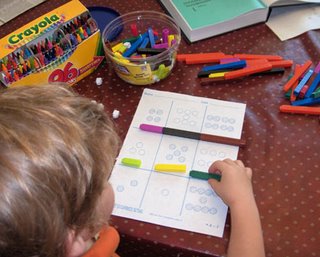
Great choice! I look forward to teaching the lessons. Kindergarten fine young gent asks to do more math. My strong-headed guy and I made a deal: We do one side of the worksheet my way and the back side is his, to do math his way. When I'm done teaching the lesson he'll sometimes spend 20-30 minutes just tootin' around with the cuisinaire rods and worksheet.

What we love:

  • The worksheets are open-ended. So far there are no written instructions on the sheets themselves. We aren't limited to what someone else thinks young ladies and gents should be learning in whatever has been determined to be the proper progression. Fine young gent can explore his own mathematical ideas. Yesterday we worked out multiplication.
  • The instructions in the teacher's manual, Lab Sheet Annotations, are open-ended, offering several ways to use each lab sheet.
  • Cuisenaire rods. The review linked above notes that Miquon works well for "Wiggly Willy." That's my kid! Wiggly, bouncy, never-still-for-a-moment Willy. Hands-on learning is his thing.
  • Bonus thing to love: The cuisenaire rods keep the Wiggly younger Willies occupied too.
  • The visual and kinesthetic experience offered by the rods and worksheets translates pretty well into more traditional math. We sometimes (for fun, mind you!) build number sentences with the rods then write them down. Or write them out and solve them some other way and check our answers with the rods.
  • Last year's worksheet-loving gent slowly soured on the whole Horizons thing, not because he didn't understand it, but because the spiral approach to math bored him-- he got it the first time. Skipping ahead several pages, we found mostly more of the same. (Not to say we didn't like Horizons. We did. It was fun, colorful, engaging. Just not a good match for the gent.) Using a completely different approach has put the spark back into math, and because it seems to be based in a very child-directed educational philosophy, I don't think we'll see the spark fizzling out.
  • Have I mentioned yet that we're having fun?

Don't love so much:

  • My sweet husband was concerned that the curriculum was first published in the 60's. I don't much care about that. It's not as though addition and subtraction have changed a whole lot since then.
  • It's pretty teacher-intensive. Actually, I don't mind at all. I look forward to teaching the math lesson for the day. Exploring the math lesson for the day.
  • Three teacher manuals? I got the Lab Sheet Annotations and skipped the other two, one a diary of a teacher's year using Miquon Math with a first-grade class and the other presenting the philosophy behind Miquon Math. Hope I'm not missing much.

Monday, September 18, 2006

What I'm Reading: Ruth Rendell

I picked up The Crocodile Bird two weeks ago at my mom's, a good solid psychological thriller by Ruth Rendell. The title was familiar, so was the picture on the front. The story wasn't. How fortunate that I decided to (I thought) re-read it, only to discover that I hadn't read it before. The Crocodile Bird unfolds as sixteen-year-old Liza, embarking on a new life, tells her life story in nightly installments to the boyfriend with whom she's run away. She recounts her protected childhood, isolated from the world on a country estate with only her mother for company. Liza's innocence about daily modern life contrasts sharply with her matter-of-fact accounts of what happened to the men who disappeared after meeting her mother.

Ruth Rendell is a master storyteller. Her Inspector Wexford crime thrillers are interesting, intelligent and satisfying to read. Mystery and crime writing at its very best. Wexford quotes Shakespeare and makes reference to Through the Looking Glass, wonders what the world is coming to, struggles with his diet and his relationships with his daughters. What makes her books so readable is that they offer more than just straight-forward whodunit mystery. Rendell must be an astute observer of people, both strengths and follies; her characters are complex and credible. Her writing offers, particularly through Wexford, low-key commentary on human nature and why we do the things we do.

Back from the weekend visit to Mom's, I picked this one up at the library. An Inspector Wexford mystery, The Babes in the Woods is the story of two teens gone missing along with the family friend staying while their parents were away.


Another library find, Harm Done adresses not only the mystery of two teen girls gone missing then mysteriously returned unharmed, but also mobs, spousal abuse, and the dilemmas posed for the police when a pedophile is released from prison back into the community after serving his time.


The Tree of Hands is the Rendell that I've enjoyed the most. As a matter of fact, I may request it from the library. If Ruth Rendell is new to you, this is a good book to start with. I'd also recommend A Judgement in Stone and The Lake of Darkness .


-------------------

One last author recommendation: More Ruth Rendell, writing as Barbara Vine. A Dark-Adapted Eye, is more psychological study than mystery, and it's gripping. Writing as Barbara Vine, Rendell doesn't follow the classic whodunit pattern in a crime is committed and a detective must follow the chain of clues to solve the mystery. Instead the novel opens as Vera Hillyard is about to hang for her crime and traces the events that lead Vera to commit the crime for which she must be hanged. I thoroughly enjoy reading Ruth Rendell novels, and I think that her Vine novels are even better. Intriguing and complex studies not just of crime, but of human nature, Vine gets at what motivates us all, and how relationships and impulses can become so knotty and twisted that they lead to (fortunately fictional) dark and bizarre crimes.

Sunday, September 17, 2006

Saturday, September 16, 2006

Science with young children

Baking Soda and Vinegar

“Dat?”

“What’s that?”

“What happened?”

“Why, why, why, why, why?”

Sound familiar? Young children are natural scientists, curious and eager to explore the world around them. They want to know the names of things, what will happen next, and why, why, why.

Preschool-aged children are at an exciting age for science exploration! It’s easy, it’s fun, and mom and dad don’t have to know the table of elements, the parts of the cell, or taxonomic identification. (Although those are fun things to know.) You just have to know that in early childhood, science is about finding patterns and figuring out the world. Observing, predicting, experimenting, and forming conclusions come naturally to young children. Drop a spoon on the floor and it falls. Every time! Watch the leaves change in the fall as the weather cools and bud in the spring as the weather warms up again. Mix water and dirt—mud! See a squirrel bury nuts, or watch a spider spin a web. Baking bread is science. Going for a walk to look for leaves is science. Pouring water into different sizes of containers in the tub is science. Counting the legs on a spider and then counting the legs on an ant—science.

As parents, we can explore right along with our budding young scientists by asking open-ended questions like “Where did the spoon go?”~ “How do you think the fly got caught in the web?” ~ “What do you think will happen next?” ~ “What might happen if?” Open-ended questions help children to form their own conclusions and shape their abilities to form hypotheses and make predictions. In addition to questioning we can facilitate learning by offering language to talk about what they see—sharing the names of things, or offering simple explanations like “The spider’s web is sticky.”

Simple science experiments allow young children to explore new ideas and they fill a rainy afternoon. Experiment with experiments. Follow the directions to see what happens, and allow children to play around with the materials. Put safe materials on a cookie tray and let them have at it, who knows what they'll discover. Don’t worry if an experiment doesn’t turn out the way it “should”. At this age it’s the process that’s important, not just the end result!

As we question and explore with our children we learn new things too. Their interests and excitement can be contagious. Before children, I never imagined that one day I’d be fascinated by earthworms-- did you know they have tiny bristles?-- or know several facts about each of the planets in our solar system. (Alas, poor Pluto. Our family is in mourning.) Encourage your children to follow their interests by providing more information on topics they find fascinating. Check out books from the library, find pictures on the Internet, or talk to someone you know who’s got more information. A magnifying glass, some yogurt cups, spoons, and kitchen supplies can get you on your way to some great experiments. Have fun!

Check out these books:

Mudpies to Magnets and More Mudpies to Magnets (Williams, Rockwell, & Sherwood)

Bubbles, Rainbows and Worms by Sam Ed Brown

For more information on science with young children:

Help Your Child Explore Science

Fun experiments


TRY ME! (Three simple experiments you can do with stuff in your kitchen)

Glop

Cornstarch

Water

Bowl, spoon

Put several spoonfuls of cornstarch into a bowl. Slowly pour water into the cornstarch a little at a time, mixing with your hands. until the cornstarch is no longer powdery. What did it feel like? Did it change as you added more water? Is the glop different when you squeeze it in your hands than it is when you let go?

(At a certain consistency the glop should make a solid when squeezed, and a thick liquid that will flow between your fingers when you stop squeezing. Try it! This is a little messy, but it’s easy to clean up.)

Swirling Milk

Milk

Glass pie pan or similar clear flat-bottom container

Dish soap

Food color

Pour some milk into the pie pan (about 1” deep). Drop in some drops of dish soap and some food color. Watch. What happens? What if you use a clear drinking glass instead of a pan? Does anything change?

(The color should swirl around in the milk. If they are a little sluggish try adding a few more drops of dish soap.)

Yeast Experiments

Yeast

Warm water

Honey

Sugar

Three small bowls or cups

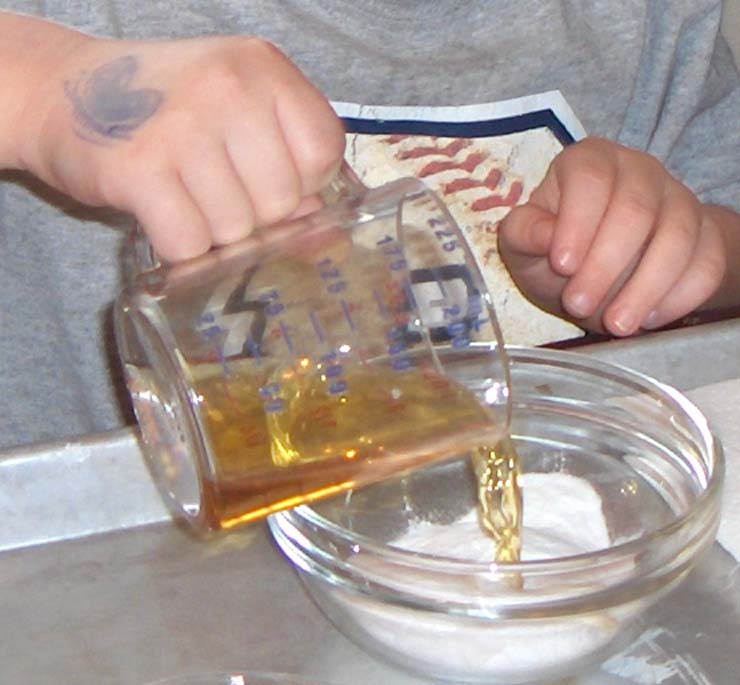
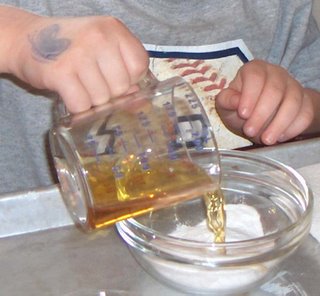
Put some warm water into three separate cups or small bowls. Sprinkle yeast over the warm water in each bowl and stir gently. To the first bowl add a little honey, to the second a little sugar, and to the third add nothing. You may want to label each bowl. Wait a few minutes and compare. What happened? (The bowl with the sugar should be the foamiest; the one with no sweetener the least.) Try the experiment again—what happens if you try three bowls with a lot of sugar, a little bit of sugar, no sugar?

Friday, September 15, 2006

Rainy Day


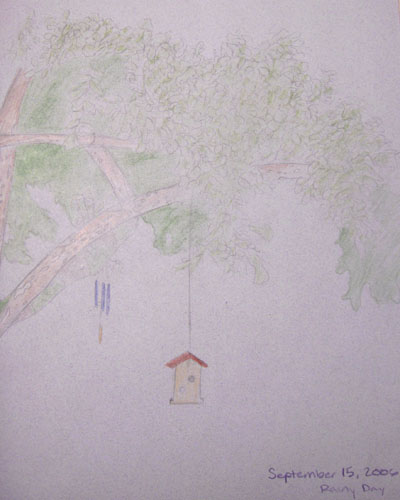
It rained today, so we postponed our plans to do some Action Painting (a la Jackson Pollock). Instead the ladies and gents sketched trees, looking out of the sewing room window. Thirteen- year-old lovely lady is doing a year-long tree study of the filbert tree in the back yard. She spent about 45 minutes on this sketch, inspiring our kindergarten gent to spend a good amount of time on his sketch.

While I was in the kitchen:

Young gent (frustrated): I can't draw!

Lovely lady: I couldn't draw like this in kindergarten. I practiced and practiced. You can draw better than I could when I was five.

YG: Really?

LL: You play the piano better than me because you practice a lot. Besides, remember? "I am always doing what I can not do, in order that I may learn how to do it. Pablo Picasso."

YG: Oh yeah!

Multi-age learning at its best.

This year's school motto, and my crazy (according to the kids) idea that we should actually memorize poems and such this school year, has already come in handy. The ladies and gents took a vote, and we ended up with the Picasso quote. I've used the motto a few times already this school year. Something along the lines of, "Of course it's hard, sweetie. If you already knew how to do this we wouldn't need to learn it, right? Remember, 'I am always.....' "

The "I don't like to draw" gent's drawing was quite detailed. My fine young perfectionist drew his sketch on the cardboard back of his sketch pad so that the white patches he colored on the trunk would show. He drew lots of green leaves. And, most importantly, he was proud of his work.


The lovely ladies decided to have a cooking class this afternoon. I tidied and corrected papers.

Mmmmmmmmmmm.....fresh snickerdoodles.


Thursday, September 14, 2006

Reason to Homeschool #49

Yesterday I wondered (briefly) why I'd ever decided to homeschool. Eight dollars, twenty minutes of my time, a good night's sleep for all and a new day helped me to remember why. They're pretty neat people and I enjoy spending time with them.

Reason #49: We have to work through it, whatever it is that's falling apart or breaking down.

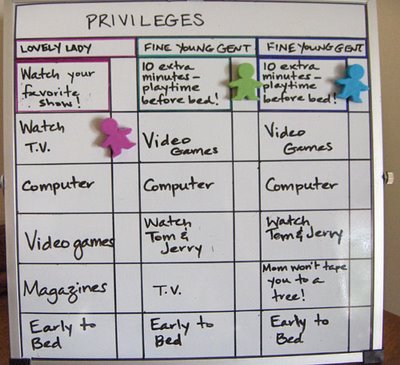
Last spring I thought if I gave fine young gent an incentive chart for practicing piano I'd stifle his natural love of music-- by providing external motivation, I'd somehow stunt his instrinsic desire to play piano. But I was tired of watching him flop off the piano bench at the outrageously unreasonable request that he play "Twinkle, Twinkle Little Star." His sticker sheet, with a Hot Wheels for a reward (naturally) got him excited about playing piano again, both lesson practices and plinking around unrewarded for fun.

I long to be one of those parents for whom those lovely contructivist child-led parenting approaches always work. I strive to honor my children's needs and honor them as persons who have wishes and desires separate from mine. I try to discipline by focusing on the positive and by gently modeling and teaching the kind of behavior I expect. And I have delightful, energetic, strong-willed children. Most days they enjoy school. Some days they have different ideas than mine about how they'd like to spend their time. Yesterday I nagged and prodded. Today a gentle reminder that they earn a reward for staying at the top of the privilege chart was all I needed. It took twenty minutes to make, five minutes to explain, two reminders. We had a smashing day.

And I wouldn't really tape anyone to a tree.

Tuesday, September 12, 2006

What the Ladies and Gents Are Reading

He's sound asleep.

Mis Colores/My Colors and other books by Rebecca Emberley are a big hit among the younger set. This fine young gent often naps with one of Emberley's board books. The other fine young gents know a few words and numbers in Spanish, partly because they (we) have read these books over and over and over and over. And as you can see, they make fine bedtime reading. If you're a year old.


The older fine young gents have been enjoying Your Big Backyard magazine. Originally a birthday gift from cousins, the magazines regularly make their way onto the bookshelves over the gents' beds so that they can read and study the pictures.


One lovely lady chose Olivia Kidney for her first free reading book of the school year. Written for 4th-6th grade(ish), it's very pink, which is why it caught my eye and screamed "This one!" as I was searching for a new book series for the lovely lady who likes books that come in sets. "I like it because it's a good book," she says. That's all I could get out of her, but she's not complaining about having to read something different, which is high praise indeed.


The other lovely lady chose The Cat of the Bubastes: A Tale of Ancient Egypt by G. A. Henty. It's a catch-up, in a way. She enjoyed studying ancient Egypt and she's a cat lover, but we didn't have time to read this book last year. How's this for a recommendation: Usually when the reading timer goes off she's off like a shot, but lately she can barely turn her attention away from the story to turn off the timer. She just keeps on reading.

Pete's Pond

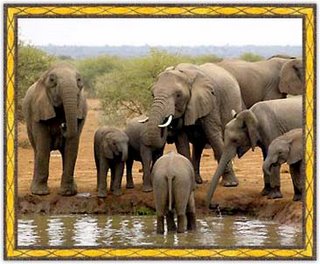
Elephants, birds, zebras brought to you live from a watering hole in Botswana. I saw a warthog and a cheetah last year. I'm off to find out what that bird is that's wading the pond.
It's a Kori Bustard.