Showing posts with label Primary math. Show all posts

Tuesday, October 14, 2008

Activity Box: Weights and Measures

Last spring, I put together a math activity box designed to encourage exploration of weights and measures. It was supposed to be for the middle young gent, and I intended to switch themes and materials by summer, but all three fine young gents still spend time with these activities so the Weights and Measures box is here to stay, for a while longer at least. It doesn't hurt that it's got materials that seem to appeal to a wide range of ages, particularly the rice and flax, the scale, the measuring tapes, and the counting bears.

This is a great box to pull out for preschool gent because unlike the Flying Paper box, the activities don't require any fine motor dexterity, so he's able to play with the materials independently. Like the Flying Paper box, we've got some ideas and materials for structured activity, and the materials can be explored independently as well.

Today we pulled it out and three-year-old gent happily occupied himself with rice, cups, spoons and the balance scale for nearly an hour, then his kindergarten brother took a turn. Two weeks ago we all played a measuring game which involved jumping on a long piece of paper, then measuring the jump using crayons, counting bears, cuisenaire rods, hands, feet, books and whatever else we could find. "Dad, I jumped twenty-five stickers!" shouted kindergarten gent later that afternoon.

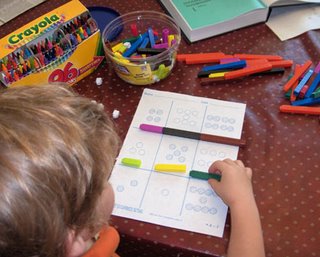
The activity pictured above asks the question "How many _____ equals 1/2 cup of rice?" We put 1/2 cup rice in one side of the balance scale, then filled the other side of the scale with blocks or cars or markers until it balanced. Great fun!

Make a Science Activity Box: Weights and Measures

You need:

A plastic tote or very large shoebox to hold materials

Scissors
Crayons
Paper (We used paper from the recycle bin.)
Graph paper
String

Measuring tapes and rulers
A compass (the math kind, not the geography kind)
A protractor

Rice, beans or flax
Measuring cups, measuring spoons, and a variety of small container
A balance scale (or the materials to make one)

Thermometers
Old watch or clock

Other supplies will depend on the specific activities you choose. Check out Mudpies to Magnets(Robert A. Williams, Robert E. Rockwell, and Elizabeth Sherwood) and More Mudpies to Magnets(Elizabeth A. Sherwood, Robert A. Williams, and Robert E. Rockwell) or another preschool math/science book from the library, borrow one from a friend, buy one or two to keep on the shelf, or search the internet for activity ideas. I print or photocopy an activity page, place the items in a large Ziploc bag or a folder, and staple the page to the bag. Instant experiment!

Our Weights and Measures activity box included these activities:

Measuring Spoons, from Family Math for Young Children: Comparing (Equals Series), p. 68-69. A measuring, counting and estimating game played with rice, cups, spoons and dice.

Beans in a Jar, from Mudpies to Magnets, p. 85. Sort beans and layer them in a small jar, then draw a picture. Sorting, graphing and art.

Look How Far I Can Jump!, from More Mudpies to Magnets, p. 183. Measure length and distance by jumping onto a long piece of paper then measuring the distance with stickers, blocks, markers, hands and whatever else you can find to measure with. Don't forget to use the measuring tape! The fine young gents have really enjoyed this activity. Extend the activity by using different items to measure your child's height, the table, or the room.

How Many Equals Equal?, More Mudpies to Magnets, p. 191. The activity pictured above, another favorite, especially with kindergarten gent.

Play with thermometers and water of different temperatures.

Measure a piece of string as long as your arm or your leg or your whole self. How many things can you find around the house that are the same length? Is the table/chair/book longer, shorter, or the same?
----------------------------------------------

For more measurement fun:

Measurement Resources, Elementary School Lessons & Materials for Teachers

Mathematics and Children's Literature, from the National Council of Teachers of Mathematics site, Illuminations

How to Plan a Preschool Math and Science Center (or activity box!)

The Path to Math: Measurement with Young Children

Thursday, March 29, 2007

Math boxes

Math boxes are simple: Take a shoe box or a plastic container, or even a file folder, and fill it with math stuff. They're meant to be a tool for independent exploration of math concepts that can lead back to a dialogue about math, creating child-guided learning opportunities. A math box can be a simple or as complex as you and your child wish. I found a book with some fun ideas, so I bought it and set up several math boxes one evening. My goal: To find some fun ways for kindergarten gent to fill those in-between spaces when he's finished one task but I'm still involved in a lesson with a lovely lady. If he goes to play I've often lost him entirely; if I hand him more "work" he gets bored and whiny. Premade purchased games like Rush Hour are dandy, but expensive. I was able to create several math shoeboxes or folders with materials we already had around the house: crayons, paper, ruler, pennies, dominoes.

Pictured above, from Shoe Box Math Learning Centers: What's In a Shape? (Creating closed shapes by gluing toothpicks to paper), Race to 100 (An adding game), a domino adding game, and Number Collage (creating rubbings using crayons and sandpaper numbers). You don't need a book, though. Pattern blocks with some crayons and printable pattern block grid paper is a popular shoebox on our shelf. We've also got a box with paper, pencil, ruler (for a number line), and dice for creating addition or subtraction problems. Cuisenaire rods in a tub, one-inch colored blocks and some pre-drawn patterns build (you can just draw the patterns yourself with a few colored markers), a ruler and a measuring chart (or just a ruler!), a tub of Math-U-See blocks, a balance scale with items to weigh, counting bears and little logic puzzles to match, macaroni and glue with predrawn pie templates....it just takes a little time and some imagination. Google can be a great help too, if you're stumped for ideas.

A math shoebox can be as structured or as open-ended as you wish. The idea is for the child to have a math activity box that can be explored independently, though it may take some pre-teaching or exploration together initially. Which isn't to say that it must be explored independently, as it's a lot of fun to sit down with the gents and try new things or gently guide some of the exploration. But to be a successful exploration box for our purposes the child should be able to pull the game off the shelf and explore in a way that's meaningful for him or her, which ideally leads back to a conversation or two about math concepts.

I thought the sandpaper numbers might be too simple for kindergarten gent, but it is something he could explore on his own or with his younger brothers. He occupied himself independently for a while. He was intrigued by the multiplication sign. "What's 9 x 9, Mom?" Which led to a mess of math blocks, more multiplication, and a lovely conversation about zeroes and multiplication. By the time we'd finished, the file folder was abandoned for a project involving writing 1 followed 50 zeroes then multiplying the entire thing by 9.


If you've got an extra shoebox sitting around, try some of these nifty ideas:

Math and Shapes in a Shoebox

Math Toolbox

Arithmetic Math Game

Free Printable Math Games

And for some overall math fun, check out this collection of links:
Links to math games, activity ideas, puzzles, articles, learning and teaching aids, freebies, math in daily life, "unschooling math," overcoming math anxiety, and much more...

And a lovely book for preschoolers with some activities that blend math and art:
MathArts: Exploring Math Through Art for 3 to 6 Year Olds by Mary Ann Kohl.

Wednesday, November 22, 2006

Greater than, less than, equal to

A flash from the past: First grade. Mrs. Jorgenson, a round grumpy woman who always wore her hair in a bun. Once she made me sit in the thinking chair* for trying on Carleena Buchanan's glasses during listening center. (Why can I remember Carleena's last name...and I can't remember what I ate for lunch today?) It's math time, and Mrs. J has just showed me how to do "greater than/less than." I was so thrilled. No one else in the class got to do this math! I proudly whipped through my paper and brought it to Mrs. Jorgenson, glowing with pride and accomplishment because I'd had so much fun doing something new.

(Her) "Some of these are wrong."

(Me) "Oh."

(Her) "Which ones are wrong?"

I stared at that paper for an eternity. They all looked correct to me. I wanted to cry because I'd felt sooooo smart and now...I couldn't for the life of me figure out what I'd done wrong.

Then she took out the pen. In my mind's eye that pen is huge, a red pen bigger than the whole world. She quickly, impatiently slashed a red mark on every single problem. I started to cry (quietly, I didn't want to be a crybaby) on the way back to my seat. I stared at the paper once I got there. I had no idea why I'd gotten them wrong....after all, in every single problem, the arrow was pointing to the larger number.

I corrected them all by turning the arrow to face the other direction. But I had no idea why. Mrs. J didn't bother to actually explain it to me.

As an adult I know that it has to do with reading from left to right, and that I had learned the concept but that my teacher had forgotten to make sure that I understood the expression of the concept. As the adult, she should have understood that when I got every single problem wrong. I had the same teacher in fourth grade. She really wasn't a bad teacher. But I still vividly remember her berating the entire class because we'd all gotten "F"s on a math test. Even then I knew there was something wrong with that. When the entire class fails or when a student gets every single problem wrong, there is a teaching problem instead of a learning problem. But I didn't know how to articulate that then, I just knew that I was going to have to go home and show my dad that I'd gotten my very first "F" ever. (Mom said she wouldn't tell. I don't know whether she did or not, but I never heard about it so if she did tell she made it clear that I was devastated. I should never make fun of my mother again.)

The lesson I learned: It is my job as a teacher to teach the task along with the concept. If a child doesn't understand something it's my job to rectify the problem, not the student's. And, most important, try not to be hasty.

Back to "greater than" and so forth. For second grade, I had Mrs. Buck. I still remember her as one of the nicest teachers I'd ever had. We reviewed "greater than/less than." Alex (or Andy or Al or some such, just go with me here) the Hungry Alligator wanted to eat more fish. So he opened his mouth as wide as he could go toward the larger group of fish. AHA!! That was why the arrow pointed the wrong way. Because it wasn't an arrow at all, it was an alligator! (It would have taken all of what, five seconds?, for my first grade teacher to explain this, by the way.) For the rest of that second grade math unit, all of my > and < had eyes and teeth.

Yesterday the fine young gent and I took a break from Miquon math and paged through a different math book until we saw something that looked like fun. And I showed my fine young gent the hungry alligator.

Look at those eyes and teeth! That's my boy, all right.

*My sister had Mrs. Jorgenson for first grade too. She never had to sit in the thinking chair, not even once. She always reminds me of that when we talk about first grade. So I thought I'd save her the trouble of posting a comment to that effect. So there!

Wednesday, September 20, 2006

Miquon Math Labs

We've already got a curriculum rave. Miquon Math Labs.


With a late fall birthday, kindergarten fine young gent would have started public school this fall. But he was asking to learn to read a year ago, so we started what we loosely called kindergarten. I chose a handwriting book because he wanted to learn to write letters, and math curriculum, and decided to wing it for the rest. Wouldn't you know, my normally relaxed about the whole thing self agonized over math curricula. First of all, was a math curriculum even necessary for a young kindergartener? Secondly, which one? Aaaughh, the dilemma posed by too many choices. And third, when am I going to learn to relax and not worry about it? It's kindergarten, for Heaven's sake. So I chose Horizons Math, a good solid workbook-based program with a lovely teacher's guide that I opened maybe twice.

(And, ugh, the whole workbook thing, that's a whole 'nother post. Wouldn't you know it, this workbooks-are-bad, "I believe in activity-based developmentally appropriate learning activities in early childhood" mom-- that would be me-- has kids who LOVE workbooks? God really wants to teach me to laugh at myself.)

Fast forward to this year. I've had a whole school year of taking myself way too seriously, so I decided to take this year off and behave like a normal rational being. Kindergarten is not the make-or-break year mathematically. It's not like he'll never master algebraic concepts, nor is it likely that he'll fail miserably at calculus if we choose the wrong kindergarten curriculum.

So what the hey? I'll give Miquon Math a whirl.

Great choice! I look forward to teaching the lessons. Kindergarten fine young gent asks to do more math. My strong-headed guy and I made a deal: We do one side of the worksheet my way and the back side is his, to do math his way. When I'm done teaching the lesson he'll sometimes spend 20-30 minutes just tootin' around with the cuisinaire rods and worksheet.

What we love:

  • The worksheets are open-ended. So far there are no written instructions on the sheets themselves. We aren't limited to what someone else thinks young ladies and gents should be learning in whatever has been determined to be the proper progression. Fine young gent can explore his own mathematical ideas. Yesterday we worked out multiplication.
  • The instructions in the teacher's manual, Lab Sheet Annotations, are open-ended, offering several ways to use each lab sheet.
  • Cuisenaire rods. The review linked above notes that Miquon works well for "Wiggly Willy." That's my kid! Wiggly, bouncy, never-still-for-a-moment Willy. Hands-on learning is his thing.
  • Bonus thing to love: The cuisenaire rods keep the Wiggly younger Willies occupied too.
  • The visual and kinesthetic experience offered by the rods and worksheets translates pretty well into more traditional math. We sometimes (for fun, mind you!) build number sentences with the rods then write them down. Or write them out and solve them some other way and check our answers with the rods.
  • Last year's worksheet-loving gent slowly soured on the whole Horizons thing, not because he didn't understand it, but because the spiral approach to math bored him-- he got it the first time. Skipping ahead several pages, we found mostly more of the same. (Not to say we didn't like Horizons. We did. It was fun, colorful, engaging. Just not a good match for the gent.) Using a completely different approach has put the spark back into math, and because it seems to be based in a very child-directed educational philosophy, I don't think we'll see the spark fizzling out.
  • Have I mentioned yet that we're having fun?

Don't love so much:

  • My sweet husband was concerned that the curriculum was first published in the 60's. I don't much care about that. It's not as though addition and subtraction have changed a whole lot since then.
  • It's pretty teacher-intensive. Actually, I don't mind at all. I look forward to teaching the math lesson for the day. Exploring the math lesson for the day.
  • Three teacher manuals? I got the Lab Sheet Annotations and skipped the other two, one a diary of a teacher's year using Miquon Math with a first-grade class and the other presenting the philosophy behind Miquon Math. Hope I'm not missing much.